
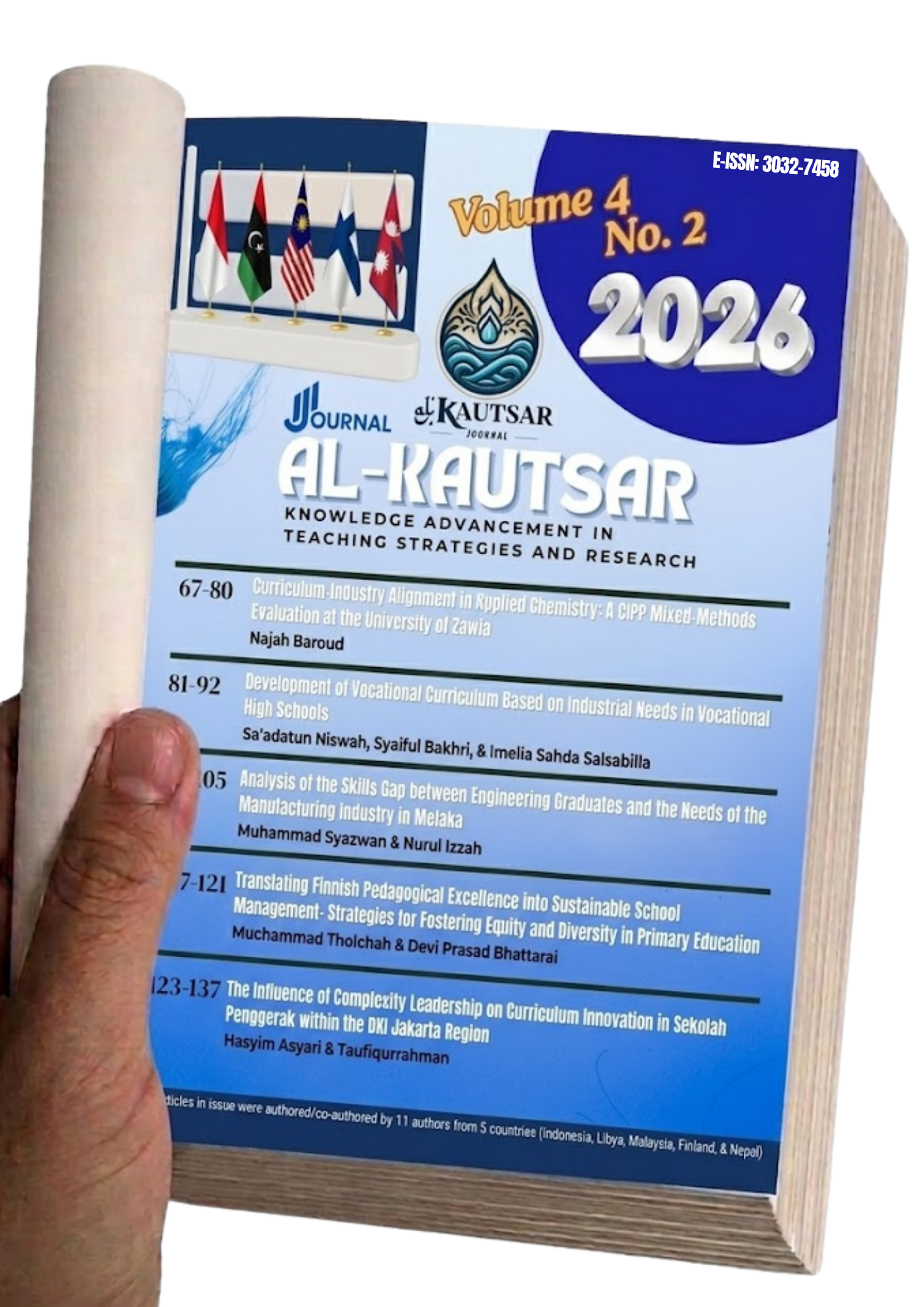
Development of Vocational Curriculum Based on Industrial Needs in Vocational High Schools
Article Sidebar
Main Article Content
Abstract
The high unemployment rate among Vocational High School (SMK) graduates in Indonesia indicates an urgent mismatch between educational competencies and industrial needs. This research aims to explore the development of an industry-based vocational curriculum through a case study at SMK Negeri 2 Semarang. Using qualitative methods, the study analyzes the curriculum adjustment process and its implications for student work readiness. Data was collected through in-depth interviews with seven respondents selected via purposive sampling, observations, and document analysis. Data analysis followed the Miles and Huberman model to ensure methodological rigor. The results demonstrate the successful implementation of the Independent Curriculum (Kurikulum Merdeka) through annual alignment with specific partners like Alfamidi and PT Metropolitan Golden Management. These findings provide theoretical implications that validate Ralph Tyler’s Theory in a modern SMK context. Despite challenges regarding work culture adaptation and school capacity, this approach effectively increases graduate employability. It is recommended that national standardization for curriculum alignment procedures be established as a practical policy measure.
Article Details

This work is licensed under a Creative Commons Attribution-ShareAlike 4.0 International License.

This work is licensed under a Creative Commons Attribution-NonCommercial-ShareAlike 4.0 International License.